Article · Digital Marketing Summit 2025, Seoul · April 2025
Hreflang Tags and Global Content Sequencing
Hreflang tags don’t just show the right page to the right market – they pass authority. What that means when you grow content across markets.
By Sebastien Edgar · 3 min read
A quick follow-up on global content sequencing, something I mentioned while presenting at the Digital Marketing Summit 2025 in Seoul.
Hreflang tags pass authority
This might be more obvious for some than others, but it’s still worth mentioning. Hreflang tags don’t just ensure, for instance, that US users see “US Product A” and French users see “FR Product A.” They also pass authority between linked pages, impacting rankings.
- In one case, broken US hreflang tags for “FR Product A” caused an immediate ranking drop in France. Fixing them restored our #1 spot.
- Similarly, when US content linked to Japanese URLs was removed, related Japanese rankings plummeted – despite no changes to the Japanese site.
- Lower authority markets (e.g. new market launches) are hit hardest by hreflang issues, while high authority markets are less affected.
- Remember that hreflang works cross-domain too. Many sites (especially in APAC) have their main domain separate from the US, so make sure those are cross-linked as well.
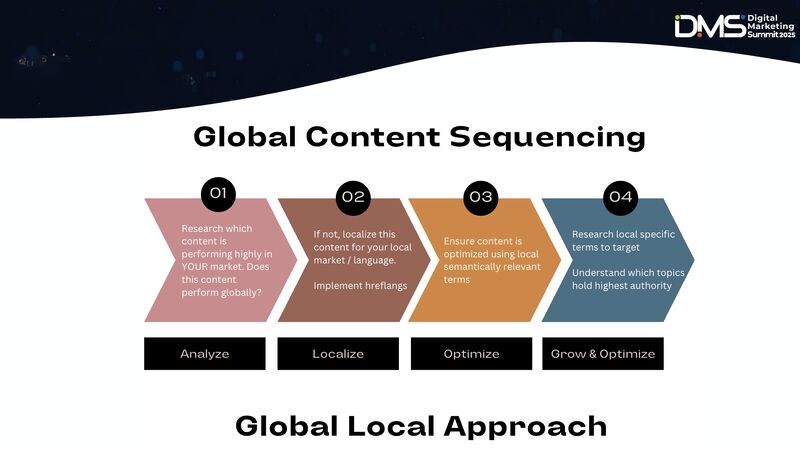
When targeting a new market, focus on topics that are relevant for the local audience and already exist in your default market. Writing an “equivalent” piece of content with local market nuance on a unique URL, connected via hreflang, will rank much faster (and better) than something that isn’t connected.
Growing content globally
With that said, when growing your content globally and across markets, focus on the following:
- Research which content performs highly in your default (or highest authority) market, and how well it performs globally. This depends on whether the content could be locally relevant (e.g. “how to start a business”).
- Localize underperforming content with market-specific URLs (e.g. /fr/) and reciprocal hreflang tags to your primary market.
- Optimize the localized content with semantically, locally relevant terms.
More articles
Panel · October 2026
Building B2B Trust in Japan and Korea: Where Content Ends and People Begin
Notes from my panel with Li Yong (Nuvei) on why global playbooks break in Japan, why Korea moves faster online, and where content should hand over to people.
Read article (8 minute read)
Panel · 2025
SEO in the Era of AI and Reduced Clicks: What’s Actually Working
From my Ahrefs Evolve panel: modular content, HTML tables, why your comparison pages get ignored by AI Overviews, and why CRO matters more than ever.
Read article (11 minute read)
Podcast · 2026
AI and Trust Are Not Competing Priorities
Podcast notes on responsible AI: monitoring drift and cost, data infrastructure, new job metrics, provenance, AEO budgets and why trust is what lets AI scale.
Read article (10 minute read)
Article · April 2026
How We Grew AI Overview Visibility From 5% to 32%
Insights from my DMS 2026 presentation: how footer, header and homepage links plus refreshed guides moved AI Overview visibility and average position at Liferay – and why ChatGPT didn’t budge.
Read article (3 minute read)
Article · January 2026
How We Grew Homepage Conversions by 79%
A simple homepage hero test at Liferay: new CTAs, a motion graphic and localized partner logos lifted CTA clicks globally – but not in every market.
Read article (3 minute read)
Article · May 2025
JavaScript Rendering for LLMs: Why Isomorphic Rendering Matters
LLM crawlers don’t render JavaScript (aside from Gemini, which uses Googlebot). Why full client-side rendering is a problem and how Next.js and Nuxt solve it.
Read article (3 minute read)
Article · May 2025
Why Your Average Position Is Misleading (and the Formula I Use Instead)
The “average position” in Google Search Console and most tools is unweighted. Here’s why that matters, and my Excel formula for a weighted average by topic.
Read article (3 minute read)
Article · May 2025
Getting Your Brand Mentioned by LLMs Starts With Association
LLMs predict the next word based on patterns in their training data. What that means for your brand, and what the temperature parameter tells us about it.
Read article (3 minute read)
Article · April 2025
Help Centers: The Most Overlooked Source of Internal Links
In my study of top SaaS brands, support pages supplied only 1.5% of internal links to conversion pages – despite having as many pages as blogs or resources.
Read article (3 minute read)
Article · April 2025
Think Page Discoverability, Not Internal Linking
From my DMS 2025 talk in Seoul: why I reframe internal linking as page discoverability, and how to build a discoverability matrix for SaaS sites.
Read article (3 minute read)