Panel · B2B Leaders Forum · October 2026
Building B2B Trust in Japan and Korea: Where Content Ends and People Begin
Notes from my panel with Li Yong (Nuvei) on why global playbooks break in Japan, why Korea moves faster online, and where content should hand over to people.
By Sebastien Edgar · 8 min read
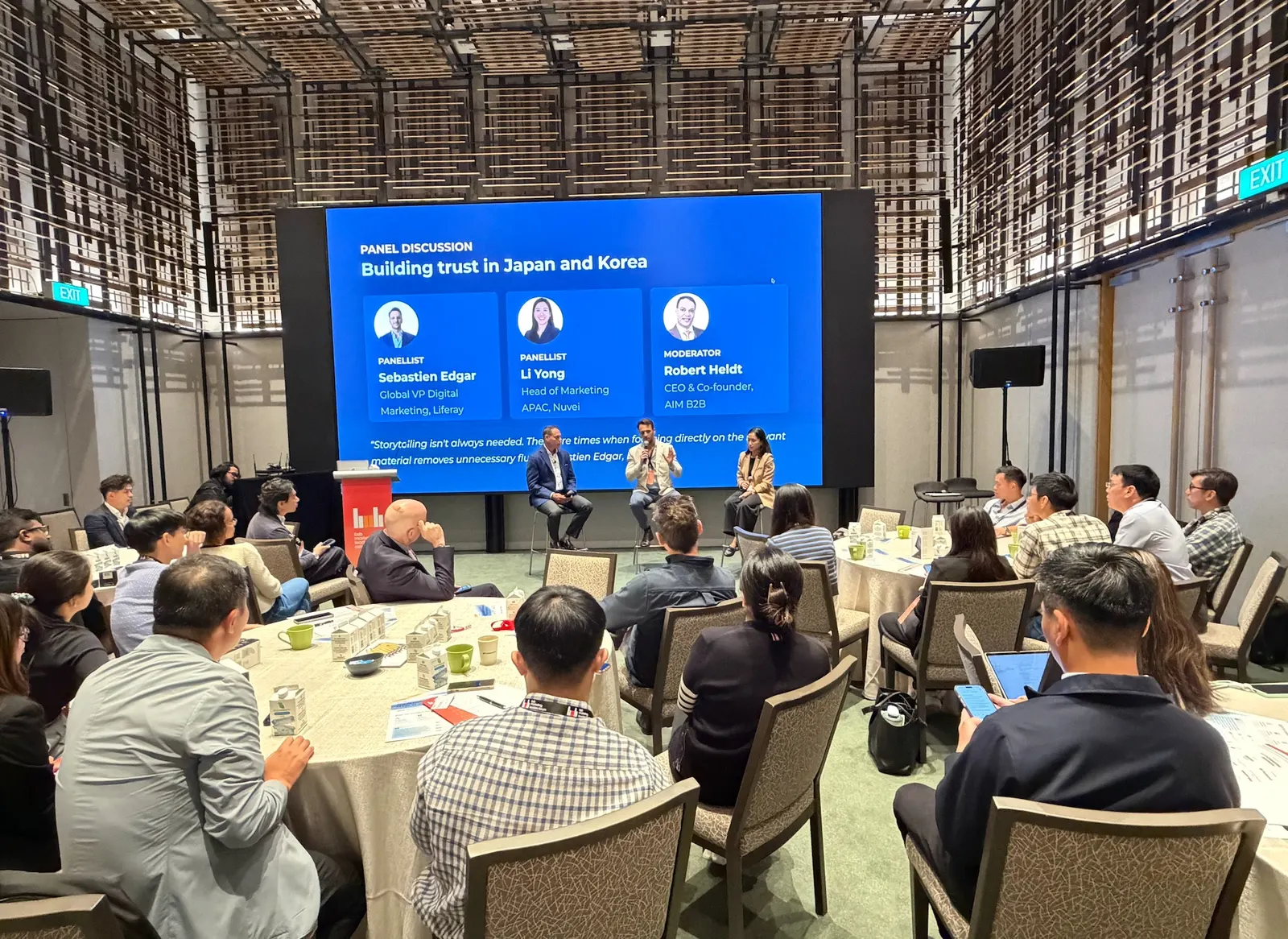
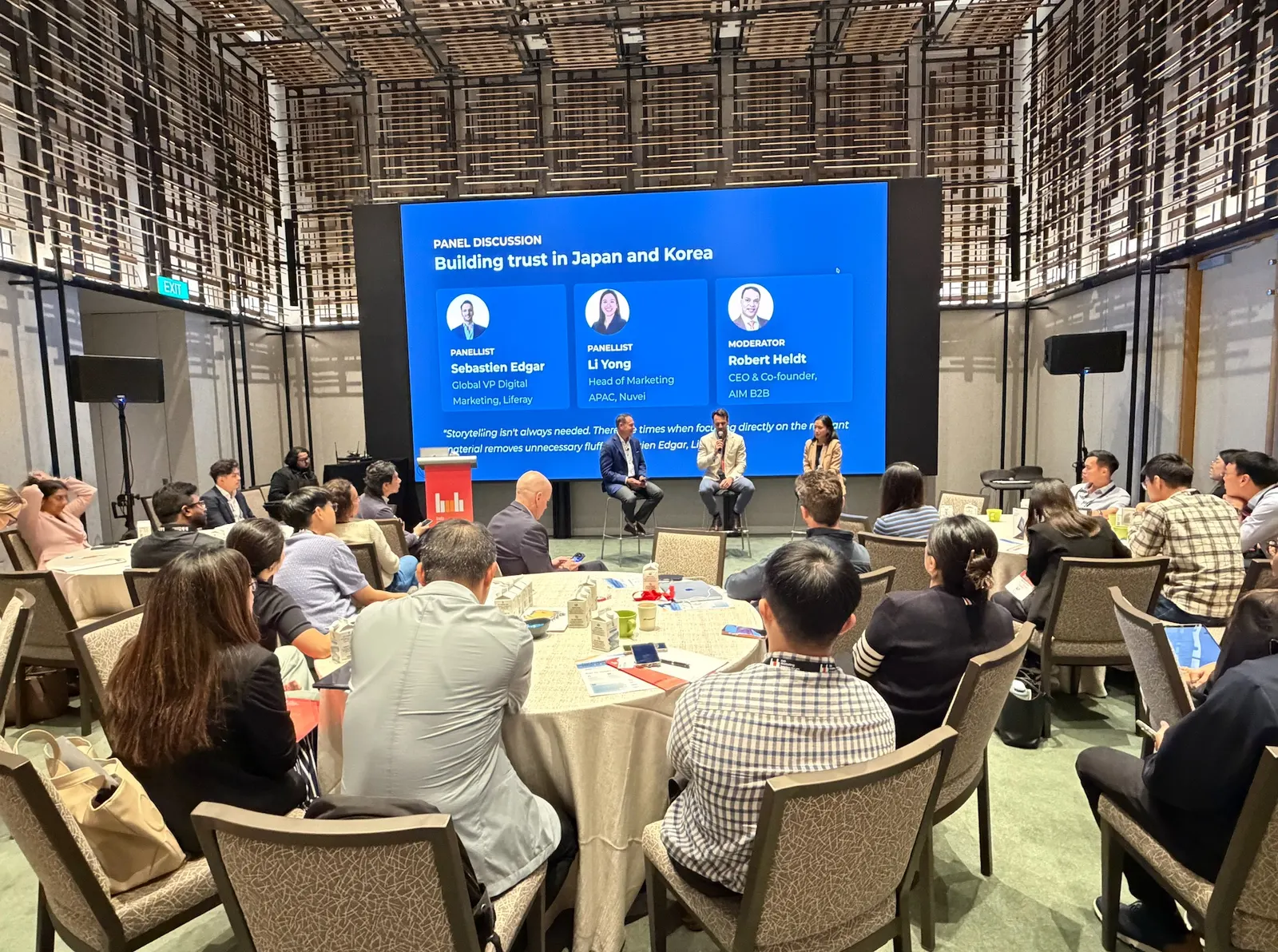
The Japan and Korea panel with moderator Robert Heldt and panellist Li Yong
I recently joined Li Yong from Nuvei on stage at the B2B Leaders Forum to talk about building trust in Japan and Korea. Having led organic growth for both markets at Square and now at Liferay, this is a topic I could geek out on for hours. Here are the main ideas I shared – cleaned up a bit, with a few of the anecdotes that got a laugh in the room.
Storytelling is a question of when, not if
One of the survey answers that came up was that storytelling isn’t always needed, and that sometimes going straight to the relevant material removes the fluff. I agree, but I’d frame it differently. It’s less a matter of if you tell a story and more a matter of when.
Storytelling is great at shaping how a buyer perceives the problem early on. It’s much less useful when that same buyer is looking for something specific. Sometimes prospects just want the facts, or an answer to their problem. Our help center at Square is the perfect example: nobody wants a narrative when they’re trying to set up a card reader.
Japan adds another layer. Buyers there are very problem focused. They’ll talk about specific pain points like reducing support calls or fixing a broken workflow, yet the search they actually type might be something as broad as “digital transformation platform.” The US is much more solution focused. Something doesn’t need to be broken for a US company to want a new vendor; if they see an improvement, they’ll buy.
So in Japan, the storytelling opportunity is to connect those specific pain points to broader business goals, show WHO else is facing the same problem, and back it up with customer stories. Then, during evaluation, switch to facts: specs, pricing, integrations and especially customer references.
Content should either help define the problem or directly provide the answer.
What breaks first when a global campaign lands in Japan
The first thing to break is the assumption that local buyers see the problem the same way global marketing does.
Take the uncertainty avoidance index, essentially how much uncertainty a culture is comfortable with. Out of 100, the US sits at 46. China is around 30. Japan is 92. That alone changes how you approach the narrative, and what you choose to focus on.
It also shows up in the data. At Square, keyword overlap between the US and Australia in the payments space was around 70%. Between the US and Japan, it was less than 20%. Our research at Liferay told the same story: local terminology and intent differ massively from global terms. A simple example is “intranet”. In Japan the preferred term is 社内ポータル (company portal). Translate the English keyword and you’re optimizing for something nobody searches.
Even commercial-sounding keywords often return educational or comparison pages in Japan, which changes the type of content you need. And comparison pages come with their own surprise: there’s an unwritten agreement not to compare yourself against local competitors. Publishing “Square vs. SMBC” in Japan is not the same as publishing “Square vs. Clover” in the US. France is similar – on TV you can’t name competitors. In the US, no problem.
Is Japan the harder room for content?
Japan-focused leaders were the only group in the survey where anyone said content has limited influence. I think part of that comes down to targeting the wrong people.
The CEO or CMO may ultimately approve the purchase, but there are often five or more people involved, and they are not the ones doing the initial research. That’s partners, managers and the team building the business case. Those are precisely the people our content needs to influence. The goal isn’t infinite content, it’s much more targeted content.
Korea is a different story. It ranked 15th globally for digital competitiveness in 2025, compared with Japan at 30th. In my experience, that translates into a greater willingness to engage digitally throughout the B2B buying journey – researching, comparing solutions and interacting with vendors online.
So I wouldn’t say content is less important in Japan. Its role is different. In Korea, content can drive buyers toward a decision. In Japan, content often validates and reinforces a decision that ultimately requires stronger personal relationships.
Where content hands over to people
The sequence I see in Japan is: digital-first research, relationship-assisted evaluation and consensus-driven purchasing.
Here’s something that surprised a few people in the room. Our most downloaded assets in Japan aren’t playbooks or feature content. They’re case studies and customer stories.
At Liferay, we work with large, old-school Japanese corporations, and many executives don’t always know how to articulate their needs. We saw an uptick in sales requests around digitizing forms and workflows (insurance claims, loan applications, order monitoring) but none of those came through search or content. Partly because we had no pages targeting the topic, and partly because nobody was searching for it. Prospects didn’t have the words yet. Those with some brand awareness came straight to us; most typed in “digital transformation” or went directly to our largest competitor.
That taught me two things. Content builds early credibility by addressing root operational issues. And the handoff moment is the shift from “How do I solve this?” to “How does your platform solve this for us?” That’s where in-person matters most. In Japan, that handoff also frequently involves system integrators and local partners, so your content needs to enable buyers, internal sales teams AND the partner ecosystem.
Who keeps you visible between meetings
For me, it’s partners. That might be unique to my industry, but once you convince them, they’ll do the marketing or selling for you (keeping in mind some partners also work with your competitors). Japan is relationship driven, and a respected local expert or customer advocating for you is far more powerful than the brand promoting itself.
On getting busy local leaders into content, I think marketers make this way too complicated. You don’t need executives writing LinkedIn posts every week. They’re already speaking to customers, attending events and sharing industry insights. Our job is to capture those conversations and turn them into content. We need to get a lot better at repurposing.
I’d even go as far as saying the face of your content doesn’t always have to be the country manager. Let solution engineers, consultants and product experts become visible voices. Their expertise creates that trust.
What to keep, what to cut
We actually cut a lot of field activity over the last two years. Our local manager left, and we didn’t notice the impact until a year later. Lesson learned.
- Keep events. In Japan they provide a LOT of value.
- Cut broad PR, or anything general and untargeted (frankly, that applies everywhere).
- Integrate events, ABM and partners instead of running them as separate programs.
- Trace content to accounts and relationship influence, not raw traffic or vanity metrics.
Reporting to HQ when year one brings few leads
Focus on leading metrics: visibility in AI search and SEO, total ranking keywords, the number of URLs ranking and getting traffic, and engagement beyond conversions. Segment the data as granularly as you can, and show how Japan trends differently from other markets and how long growth is taking compared to them. If you look at conversions, look at quality over quantity – lead to MQL rates rather than raw lead counts.
In the end, the results themselves matter less than the clarity of what you’re showing and why. You’re building confidence that the trend will turn into growth. Short-term pain for long-term gain.
One thing to stop doing
Slightly conflicting answer. Stop copy-pasting global playbooks into Japan; US campaign success doesn’t equal local relevance. At the same time, don’t overcomplicate things. We’re all dealing with people, and while these markets are very different, a lot of the fundamentals still apply. Find that balance using your own data and metrics.
More articles
Panel · 2025
SEO in the Era of AI and Reduced Clicks: What’s Actually Working
From my Ahrefs Evolve panel: modular content, HTML tables, why your comparison pages get ignored by AI Overviews, and why CRO matters more than ever.
Read article (9 minute read)
Podcast · 2026
AI and Trust Are Not Competing Priorities
Podcast notes on responsible AI: monitoring drift and cost, data infrastructure, new job metrics, provenance, AEO budgets and why trust is what lets AI scale.
Read article (10 minute read)